Solving the wrong problem
Sep 29, 2026Submission to Australian Government Consultation: Better targeting the Research and Development Tax Incentive – exposure draft
- Date: 18 September 2026
- Author: Paul Klink
I run a small software startup company focused on trading, registry and productivity services. To challenge my writing skills, I occasionally write articles covering R&D and productivity. In response to the SERD discussion paper, I submitted a response questioning why invention/innovation was out of scope.
More info: https://paul.klink.au.
R&D vs Innovation
The Strategic Examination of Research and Development (SERD) report made a genuine attempt to identify strategies to increase R&D within Australia.
But what if it was solving the wrong problem?
A major shortcoming of the report is that it made little attempt to define what R&D actually is and to explain the economic reasons for why more R&D is good for an economy. It just proceeds on this assumption, and also, the more the better.
What really drives the economy is innovation. Innovation converts knowledge and technology into value (new or improved products and services)1. R&D is an input into innovation. It supplies new knowledge and technology. However, innovation can also use existing knowledge and technology. This is shown in the following diagram
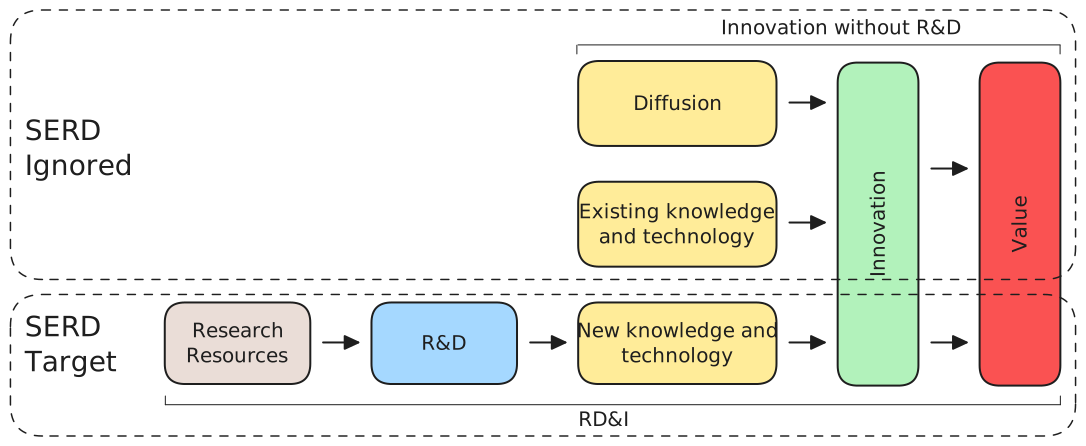
Productivity: Non-R&D Innovation vs RD&I
We can categorise innovation into two types: Non-R&D innovation and RD&I (R&D innovation). Both types of innovation drive productivity in an economy but in different ways.
- Non-R&D innovation has a higher impact on productivity at an aggregate level, due to its volume, frequency and price competition. Essentially, it raises the floor of productivity. Because of its lower cost and closer proximity to customers, it builds broad entrepreneurial capacity and innovation commercialisation skills.
- RD&I has a higher impact per event (successful release) but low frequency. These events raise the ceiling of what is economically possible — but they are too infrequent to carry aggregate productivity growth on their own. Because of the higher complexity of RD&I projects, RD&I fosters deep and narrow expertise, and builds specialised commercialisation skills.
There is substantial synergy between these innovation types23. Companies implementing large-scale innovation projects often need innovative small suppliers to provide the components and tooling at competitive prices4. This synergy is reduced when only RD&I is incentivised by the government.
Separately, there is evidence of diminishing returns when RD&I incentives increase in isolation from broader innovation support.567
Balance Support Across Innovation Types
The current tax arrangements do not support non-R&D innovation8. However, they do support small RD&I projects which share some characteristics with non-R&D innovation. The proposed tax law changes:
- raise the minimum R&D expenditure threshold from $20,000 to $50,000.
- increase the expenditure cap to $200 million.
Together, these changes redirect allocation of government resources away from small RD&I projects and into RD&I projects with large-scale potential. This change is compounded by the draft ignoring the SERD’s recommendation to introduce an R&D Collaboration Voucher program (Recommendation 6). Together, these are analogous to sporting codes removing support for grassroots development. The evidence suggests a proper balance of R&D/innovation tax incentive support would redirect resources in the other direction and include non-R&D innovation.
Unfortunately, the fix for this is not simple. A further strategic examination is needed to investigate how non-R&D innovation should be supported to both complement and balance RD&I. The investigation should include productivity as high-priority criterion and include productivity economics expertise on its panel. Its report can then recommend how government support for both innovation types can be sustained.
The big ask
I know it is a big ask, but please do not proceed with these changes to tax law. Improving productivity growth is hard. However, it is probably the main game in town. Tax law covering R&D and innovation support should not be changed until a good balance is struck between non-R&D innovation and RD&I.
Footnotes
- R&D vs Innovation - A productivity perspective ↩
-
The OECD’s innovation systems literature consistently finds that R&D-based and non-R&D-based innovation are mutually complementary rather than substitutes: “Successful firms are those that couple R&D-based and DUI modes of innovation” and “incremental innovations are prerequisites for more ambitious innovation efforts” (OECD, 2019). Concentrating support on R&D clusters without supporting the broader innovation ecosystem risks an “enclave trap” in which subsidised firms operate in disconnection from the wider economy (OECD, 2020). Finland’s experience of over-concentrating innovation support in large R&D performers is a cautionary example: the OECD concluded that its innovation ecosystem needed “a more diverse set of firms, industries and technologies” and that government must deploy support instruments that reach beyond formal R&D performers (OECD, 2022). The OECD’s earlier foundational work also notes that “technology diffusion is just as important as R&D and innovation to productivity growth” and that, at an economy-wide level, it is the diffusion and use of innovations — not their initial invention — that generates the major economic benefits: Managing National Innovation Systems (OECD, 1999). ↩
-
Fostering Innovation in less-developed and low institutional capacity ↩
-
Fiscal incentives for business R&D: Compendium of evidence on the effectiveness of innovation policy intervention ↩
-
Australian Tax Office: Eligibility for the R&D tax incentive ↩