R&D vs Innovation - A productivity perspective
Sep 28, 2026What is the difference between R&D and innovation?
This is not an academic question. Both are vital1 for the economies of advanced countries. However, the risks associated with R&D and innovation are large and this deters companies from carrying out these activities. So governments subsidise2 them — to the tune of billions of dollars.
In order for companies to access these subsidies, it can make a big difference whether they are undertaking R&D or standalone innovation activities. This article explores the difference between R&D and innovation and considers the different benefits they provide to an economy.
Definitions
Many articles and documents use the term R&D loosely — treating it as interchangeable with innovation or RD&I, or some combination of all three. This can be confusing and misleading so it is important to have a clear understanding of these terms.
-
R&D (Research and Development)
From OECD’s Frascati Manual (2015)3 we get:
R&D is the systematic, creative process of generating new knowledge. It encompasses activities — from basic and applied research through to experimental development — that are novel, uncertain in outcome, and aimed at increasing the stock of knowledge or devising new applications of existing knowledge. R&D does not, of itself, produce a marketable product or service; its output is knowledge.
The Australian Government take this one step further by stipulating that, in addition to R&D requiring systematic processes, the processes also need to be based on Scientific Method. This limits its applicability and creates significant barriers for R&D in fields such as software development, design, and social innovation, where hypothesis-driven experimentation is not standard practice.
-
Innovation
From OECD Oslo Manual (2018)4 we get:
Innovation is the process of translating knowledge — whether new or existing — into products or services that deliver value. An innovation is a new or significantly improved product or process that has been introduced to the market or brought into use. Innovation does not require the generation of new knowledge; it may draw entirely on existing knowledge, technologies, or methods to create something useful.
That is, innovation is the process that creates or improves a sellable product or service.
-
RD&I (Research, Development & Innovation)
The term R&D is often conflated/confused with RD&I. RD&I combines R&D with innovation. From OECD Frascati/Oslo Manuals3 4, and RD&I value chain literature5:
RD&I is the integrated, end-to-end process that links the generation of new knowledge (R&D) with its commercial or practical realisation (Innovation). It represents a value chain in which research produces new knowledge and technologies, development refines these into workable solutions, and innovation brings those solutions to market. RD&I is therefore a subset of the broader innovation landscape — it is innovation that is specifically driven by prior R&D activity.
In the rest of this article the terms R&D, innovation and RD&I have the above meanings.
Differences
A wry, pithy observation of the difference is:
R&D is turning money into ideas, but innovation is turning ideas into money
R&D is an input into the innovation process whereas innovation generates the economically (or socially) valuable output. The intermediary between them is “knowledge and technology”. Diagrammatically this can be shown as:
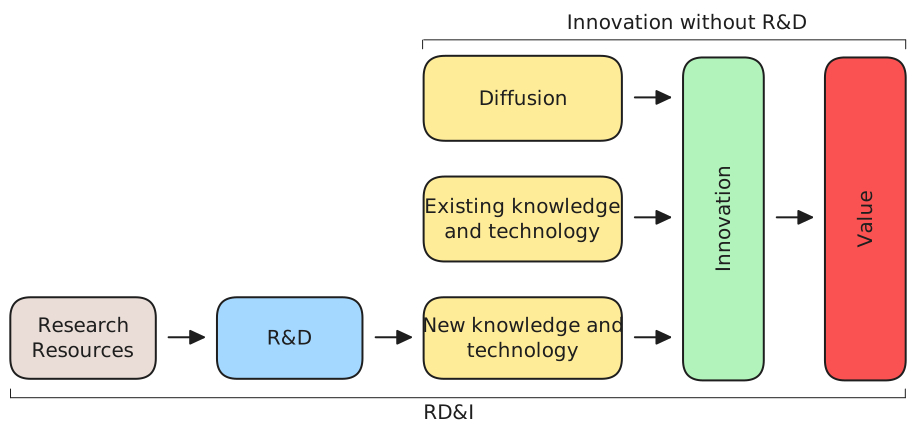
Accordingly:
- R&D focuses on creating knowledge and technologies
- Innovation focuses on using existing knowledge and technologies to create value through new or improved products and services.
RD&I combines both these 2 processes. The critical distinction is that R&D must be followed by innovation in order to generate economic value; however, innovation often does not need R&D.
RD&I vs Non-R&D innovation
Ultimately, it is innovation that adds value to the economy. When governments consider innovation policy, the big question is not simply whether to support R&D or innovation, it is the extent of support (subsidies) provided to different types of innovation. To that end, let us compare RD&I and non-R&D innovation across several dimensions:
-
Cost
Non-R&D innovation is inherently less expensive to carry out than RD&I. Accordingly, these innovators face lower financing constraints and have more flexibility in undertaking innovation activities.
Government incentives may still be needed to encourage non-R&D innovation, however, the amount should be less than incentives needed for RD&I and can be spread across many more organisations.
-
Price
Non-R&D innovation is very often process-based and used to drive down prices — the benefits flowing to consumers as lower prices. RD&I however is more focused on new product categories and performance breakthroughs. When successful, the resulting products and services sell at a price premium until competition catches up6.
-
Competition
The incremental nature of non-R&D innovation drives down pricing while mostly maintaining competitive markets (provided competitors also innovate). However, successful releases from RD&I can destroy markets (creative destruction — the process by which innovations make existing products obsolete) and lead to monopolies until new entrants can break in.
-
Local vs Global reach
The lower costs and complexity of non-R&D innovation allow more firms across wider areas to participate, distributing economic gains broadly across the economy. However, the spillover from RD&I diminishes quickly and will be limited to university and research precincts, which tend to be geographically concentrated7.
-
Research output channel
RD&I is a major output channel for research organisations (universities and research institutions) and highly valued by these organisations. As significant recipients of public research funding, these organisations tend to be well-represented in policy discussions, and may use this influence to shape government priorities away from non-R&D innovation.
-
Ecosystem
Non-R&D innovation builds broad entrepreneurial capacity whereas RD&I builds deep and narrow expertise. The number of SMEs undertaking non-R&D innovation is approximately three times the number of R&D-active SMEs8. The greater participation rate of non-R&D innovators develops a more diverse innovation and skills base.
-
Commercialisation skills
The shorter path to market and lower capital costs of non-R&D innovation provide companies with greater opportunity to commercialise innovation. This is where innovation policy should focus to build general innovation commercialisation skills. However, RD&I enables the development of specialised commercialisation skills relevant to complex and large-scale innovation.
-
Productivity
Non-R&D innovation has a higher impact on productivity at an aggregate level, due to its volume, frequency and price competition. Essentially, it raises the floor of productivity. RD&I has a higher impact per event (successful release) but low frequency. These events raise the ceiling of what is economically possible — but they are too infrequent to carry aggregate productivity growth on their own.
Why Productivity Favours Non-R&D Innovation
The productivity case for non-R&D innovation rests on a well-established distinction: incremental vs radical innovation.
RD&I produces paradigm shifts which can radically change a marketplace. They are rare and expensive — but when they land, they are newsworthy, carrying an air of prestige, controversy, and occasionally national pride, which inevitably draws them into the world of politics.
In contrast, non-R&D innovation is the quiet background worker doing the hard aggregate lifting for productivity — with no fanfare. Its incremental and continuous improvements to process and design, reduce costs, increase quality, sharpen competition, and pass value to consumers through lower prices. The individual innovations themselves may be less ambitious than those resulting from R&D, but due to their volume, they account for a substantial share of economy-wide productivity improvements8.
Government Innovation Policy
Governments subsidising innovation need to understand the difference between R&D, innovation, and RD&I — and to reflect that understanding in how they allocate support. With productivity growth weak in most advanced economies, the direct impact on living standards makes this a policy choice that matters.
Some governments limit their support to RD&I — and narrow it further still by requiring the scientific method9. This concentrates subsidies on a small subset of innovation activity while leaving the larger, more accessible, and arguably more productive world of non-R&D innovation without support. The evidence suggests the returns from this approach are not only limited, but diminishing.
Footnotes
-
Why Research and Development Is More Important Than Ever — Note, as with many articles it uses the term R&D to cover both classic research driven R&D and innovation. ↩
-
In 2025/26, the Australian government spent roughly $6.2 billion on subsidising R&D activities within Australian companies ↩
-
The RD&I value chain concept is formally recognised in the European Commission’s Framework for State Aid for Research and Development and Innovation (OJ C 414, 2022), which describes RD&I as “a series of activities… upstream to a number of product markets” leading to new or improved products and services. The underlying value chain structure — from idea generation through development to commercialisation — is elaborated in Hansen & Birkinshaw, “The Innovation Value Chain”, Harvard Business Review, 85(6), 2007. ↩
-
Localizing the economic impact of research and development ↩
-
Types of SMEs in the innovation system: activities, constraints and successes ↩ ↩2
-
Australian Tax Office: Eligibility for the R&D tax incentive — specifically the requirement that core R&D activities follow “a systematic progression of work based on the principles of established science, proceeding from hypothesis to experiment, observation and evaluation.” ↩